
Fusion and runes: the crafting guide
2 players make 1 rune of the tier above, 5 runes make 1 player. Exact magic ball costs, how recycling differs, and the mistake that burns 50 magic balls.
The 5 rune rarities
 Uncommon
 Rare
Rare Epic
Epic Legendary
 Mythic
- 2 identical players make 1 rune of the rarity above
- 5 identical runes make 1 player of that rarity
- It is the game's only rarity ladder
10 magic balls50 magic balls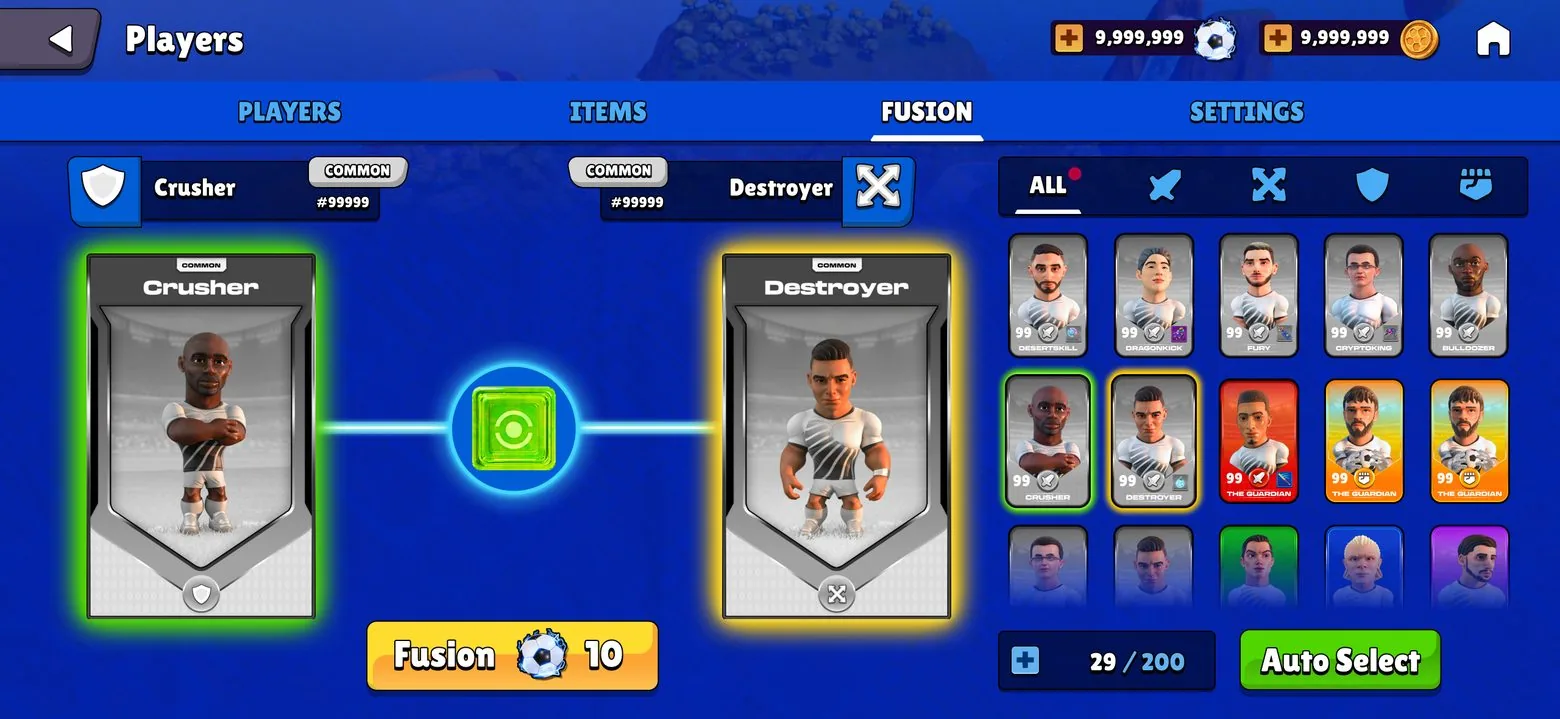
Fusion is two operations. Not three, not ten. Both are paid in magic balls, both destroy whatever you feed them, and neither will let you mix rarities. Learn those two recipes and the whole crafting side of Kickdom fits on one page.
The two recipes
| Operation | In | Out | Cost |
|---|---|---|---|
| Player fusion | 2 players of the same rarity | 1 rune of the next rarity up | 10 magic balls |
| Rune fusion | 5 runes of the same rarity | 1 player of the same rarity | 50 magic balls |
Compare the two output columns. That difference is the entire point of this page. The first line climbs a rarity tier. The second one does not.
Player fusion: 2 players make 1 rune of the tier above
Take 2 players of the same rarity, pay 10 magic balls, get back 1 rune of the rarity directly above. Both players are destroyed in the process.
Three examples to lock it in:
- 2 common players make 1 uncommon rune
- 2 rare players make 1 epic rune
- 2 legendary players make 1 mythic rune
This is the only rarity elevator in the game, and it is the engine of the whole crafting loop. Nothing else turns material into higher-tier material. Not recycling, which only pays out currency. Not rune fusion, which holds rarity flat. Not the lab either: upgrading it improves your odds, it never promotes a player a tier.
So here is the takeaway. Your duplicates are not junk, they are the steps of the staircase. Every pair you fuse moves you one tier closer to the top, and no other route goes there.
Which explains the highest rarity in the game. A mythic rune is 2 legendary players fused. The mythic guide walks the full route, costed step by step.
Rune fusion: 5 runes make 1 player
Five runes of the same rarity, 50 magic balls, and you get 1 player of that rarity. All five runes are gone.
Watch the trap: there is no tier gain here. 5 epic runes give you an epic player, never a legendary one. Rarity climbs when you fuse players, not when you fuse runes. This is the most common misread in the game, and it costs 50 magic balls to learn the hard way.
Rune fusion does hold one privilege though. It is the only way to obtain a mythic player. The lab stays at zero mythic on every level from 1 to 40, and chests will not hand you one either. Five mythic runes fused, and nothing else.
Two rules that never bend
Cross-rarity fusion is blocked. An epic player and a legendary player will not fuse. Four rare runes plus one epic rune will not either. The game wants strictly matching rarities, in both operations, every time.
There is no item fusion. You never fuse two items, whatever their rarity. A worn item gets repaired by watching an ad, or recycled for magic balls. That is the full list of what you can do with it.
Recycling: the thing people confuse with fusion
Recycling destroys one player, or one item, at a time and pays you magic balls for it. No combining, no rarity gain, no entry cost. It is the mirror image of fusion: it produces exactly the currency fusion spends.
It is also the main source of magic balls in the game.
Recycling a player
| Rarity | Magic balls |
|---|---|
| Common | 5 |
| Uncommon | 10 |
| Rare | 25 |
| Epic | 50 |
| Legendary | 100 |
| Mythic | 250 |
Recycling an item
| Rarity | Magic balls |
|---|---|
| Common | 2 |
| Uncommon | 5 |
| Rare | 12 |
| Epic | 25 |
| Legendary | 50 |
At equal rarity, a player pays two to five times what an item pays. A recycled legendary player returns 100 magic balls, a legendary item returns 50. Worth knowing when storage is bursting and something has to go.
The full loop, in three moves
Here is how the three operations chain together in practice. This is the cycle you repeat all season.
- Recycle what is finished. A player at 0 playable matches does nothing for you on the pitch. Recycled, it turns back into crafting currency. A spent legendary returns 100 magic balls.
- Fuse your duplicates into runes. Two same-rarity players you never field, 10 magic balls, and you are holding a rune one tier higher. This is where a collection gains value instead of leaking it.
- Fuse your runes into a player. Five runes of the rarity you actually want, 50 magic balls, and a fresh player joins the roster with a full match counter.
The circuit closes itself. Recycling funds fusion, player fusion manufactures rarity, rune fusion puts that rarity back on the pitch.
Recycle or fuse: how to decide
A duplicate always poses the same question, and both answers are correct depending on the moment.
Recycle a legendary and you get 100 magic balls right now. Fuse two legendaries and you spend 10 magic balls to hold a mythic rune. Recycling pays. Fusion prepares.
The short rule: recycle what is spent, fuse what is spare. A player at 0 matches has no play value left, only scrap value. A fresh player you never field is raw material, not waste.
One exception worth carving into the wall: never recycle a legendary if you are aiming at a mythic. You need ten of them.
Where runes come from besides fusion
Player fusion is not your only supply. Runes also drop from chests and from season pass, quest and referral rewards. Mythic runes are no exception here: unlike mythic players, they do come out of those pools. The shop lists them as super deals too, 200 gems for a legendary rune and 400 gems for a mythic one. Currencies and pricing are covered in the economy guide.
That leaves one question: is what you are crafting actually worth it. The 6 rarities, what each one changes on your stats and on your playable match count, all live on the players page. That reading is what decides whether a fusion earned its magic balls.
Production values, adjustable by the team.