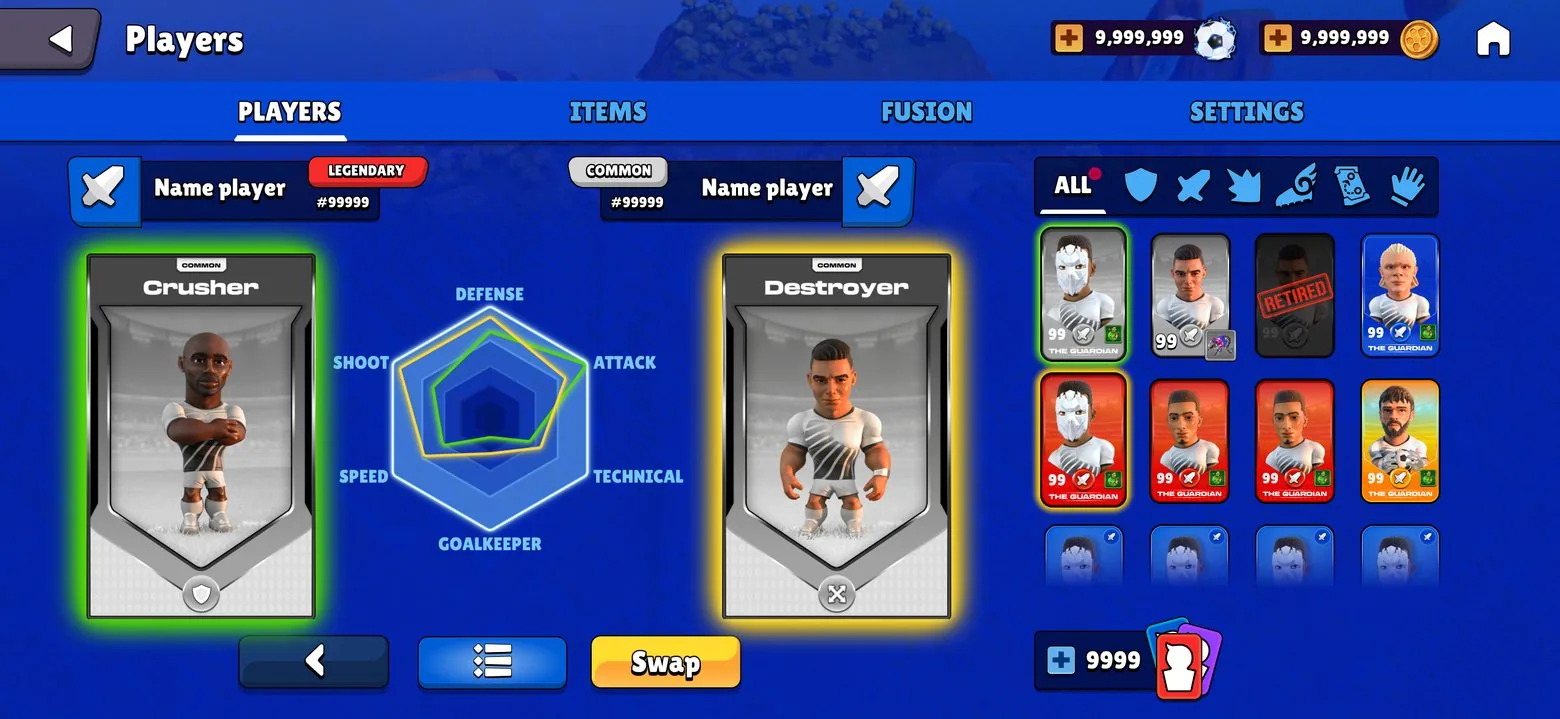
Players: rarities, stats and overall
The 6 rarities, the 6 stats, the overall and the match counter every player carries. What rarity genuinely changes, stat by stat and match after match.
The 6 stats
 DefenseAttack
 Goalkeeping
 Technical
 Speed
Speed Shoot
Shoot- Overall sums the 6 stats, open the detail to decide
- Rarity sets both power and lifespan
- maxGames drops with every match played
A player is the base unit of Kickdom. You field five to start a match, your collection has no cap, and two numbers tell you almost everything about any given player: its overall and its maxGames. Here is how to read them.
The 6 rarities
In ascending order:
common → uncommon → rare → epic → legendary → mythic
Rarity is not a cosmetic label. It sets two things at once: how strong a player is, and how long it lasts. The second half is the part most people miss, and we come back to it below.
Mythic sits apart. It never comes out of a draw, not from the laboratory, not from a chest. There is exactly one route to it, and it is covered in the mythic guide.
The 6 stats
Every player carries six stats: defense, attack, goalkeeping, technical, speed, shoot.
Each one is rolled when the player is created, inside a range set by its rarity. So no two legendary players are alike. Same range, different rolls.
Overall, and level
The overall is the average of the six stats. One number, instant comparison. Useful, and a little misleading: two players with the same overall can be shaped in opposite ways, one loaded with shoot and attack, the other with defense and goalkeeping. Open the detail before you lock your lineup.
Every player also carries a level, alongside its six stats and its overall.
What rarity does to your stats
Rarity works on every stat in two ways, and you have to keep them apart to see the real gap between a common and a mythic.
It raises the ceiling. A higher rarity widens the band each stat is rolled in, upward. A common simply cannot reach the values a legendary hits without straining, and a mythic goes higher still. The floor lifts too: a high rarity player never bottoms out the way a badly rolled common does.
It raises your odds of rolling high inside the band. This is the effect everyone forgets, and it is the bigger one. A high rarity player does not just get a taller ceiling, it lands far closer to that ceiling far more often, on every stat. Both effects stack, six times over, once per stat. That stacking is what opens the gap between two rarities, well past anything the ceiling alone suggests.
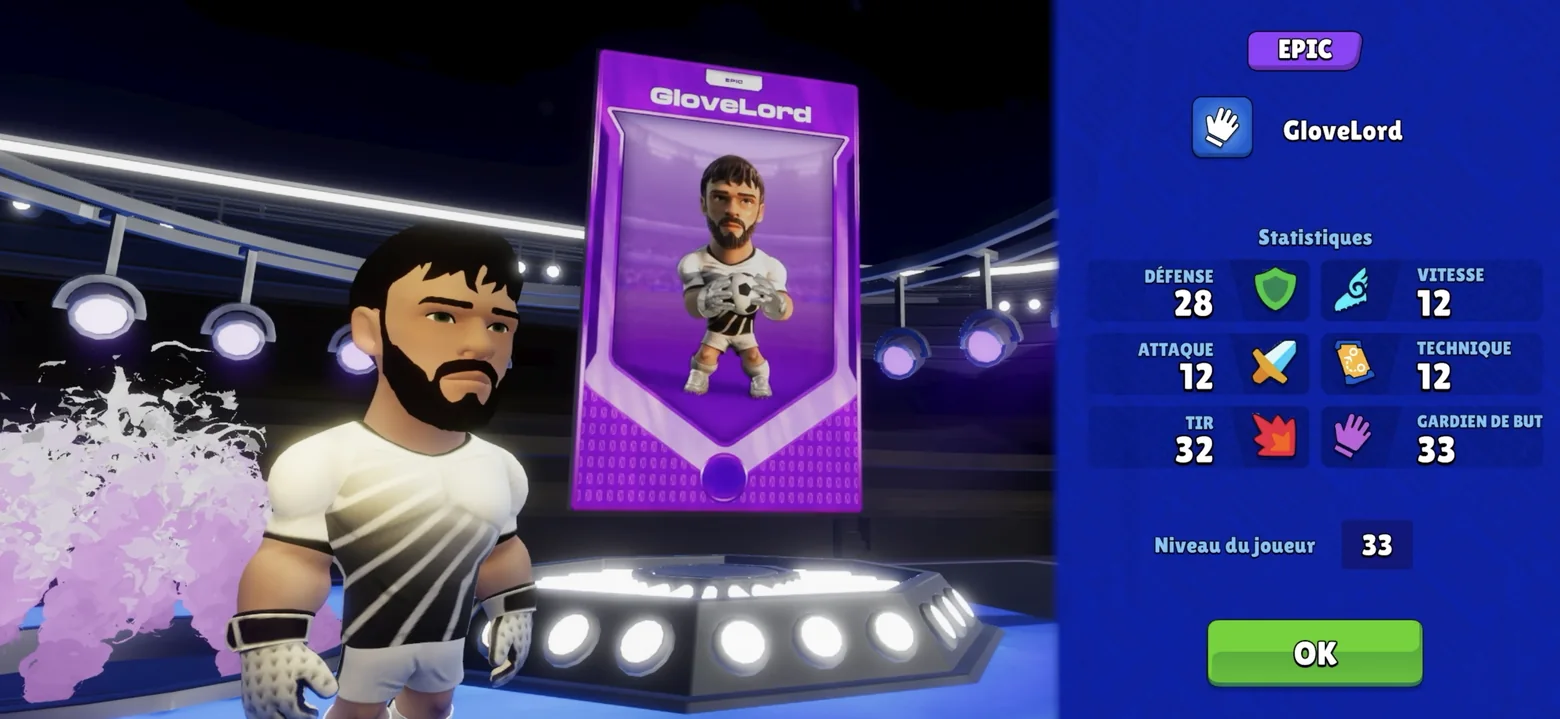
The practical consequence matters when you build a line-up: two players of the same rarity are not equal. Same band, different rolls. A well rolled legendary and a badly rolled one are not the same player. Use the overall for a first pass, then open the 6 stats whenever two overalls sit close together.
maxGames: a player is a resource you spend
Every player carries a maxGames counter: how many matches it has left. It drops by 1 per match, for every player in the lineup. At 0 the player is spent. It cannot play. Recycling is all that is left.
That counter tracks rarity, and the scale is wide. A common lasts a few dozen matches. A mythic lasts several hundred. Between the two, every rarity tier stretches the player's life noticeably.
This is what newer players underestimate most. A player is not a permanent purchase. It is stock you burn, match after match. A common burns out fast. A mythic holds its place in your line-up for weeks.
Why rarity counts twice
Here is the takeaway. Moving up one rarity buys you two things, not one:
- Higher stats. The ceiling lifts, and you roll high inside the band far more often.
- A longer life. From a few dozen matches at common to several hundred at mythic.
So a legendary is not "slightly better" than a common. It hits harder and it lasts a great deal longer. Per match played, a high rarity player costs far less than its price of entry suggests.
Practical corollary: there is no such thing as a free match. Every match you play with your legendary comes off its counter. Pick your moments.
The 4 ways to get players
The laboratory. The main source. Each research produces a player, and your lab level pushes the mix upward: fewer commons, more uncommons, rares and epics. Legendary stays rare at every level there, and mythic never comes out of it at all. The detail is in the laboratory guide.
Rune fusion. 5 runes of the same rarity give 1 player of that rarity, for 50 magic balls. This is the only way to get a mythic. Both fusion operations are detailed in the fusion guide.
Chests. All 10 chests in the game contain players, and they get richer the closer you get to the Mythic chest.
Rewards. Season pass, leagues, quests, starter pack, referrals: players drop regularly without spending anything.
What to do with a spent or spare player
Recycling destroys it and returns magic balls: 5 at common, 10 at uncommon, 25 at rare, 50 at epic, 100 at legendary, 250 at mythic. It is the main source of magic balls in the game.
A fresh duplicate deserves better. 2 players of the same rarity fuse into 1 rune of the tier above, for 10 magic balls. That is the only rarity elevator in Kickdom, and the first step toward a mythic.
Weigh the two options before you act. Recycling a legendary pays you 100 magic balls on the spot. Fusing it with a second legendary costs 10 magic balls and returns a mythic rune instead, and mythic runes are the only path to a mythic player. Same collection, two very different outcomes.
Players and items work together
A lineup is 5 players plus up to 5 items, with a maximum of 1 item per player. Items are optional, and they wear on the same rule: 1 durability per match played. One key difference, an item can be repaired. It is all in the items guide.
Production values, adjustable by the team.